
The ability to strike a balance between resilience, economic efficiency and long-term development determines whether the energy sector will be a pillar of business or its weak point.
Just a few years ago, most companies took the availability of energy for granted. Electricity was in the socket, gas was in the pipes, and the main concern remained the price. Events since 2022 have fundamentally disrupted this certainty. Price fluctuations, supply uncertainty and geopolitical risks have shown just how quickly energy can shift from being a routine operating expense to a factor that restricts production, increases costs or threatens the very survival of an entire business.
Companies have therefore begun to seek alternative sources, are more frequently considering in-house generation, and are reassessing their dependence on individual commodities. Some have responded by cutting back on production, whilst others have passed on the higher costs to their prices. However, neither approach is a universal panacea. A business that is prepared for such situations can manage the changes without major disruptions to operations and without having to make crisis decisions under time pressure.
Energy security cannot, therefore, be reduced to the question of how much a company pays for its energy. Nor can it automatically be equated with maximum self-sufficiency. The aim is not to seal the business away in an energy-isolated bubble. The objective is to reduce dependence where it poses a genuine risk and to prepare operations for situations that may have significant economic repercussions.
Security has two timeframes
It is useful to divide energy security into two levels. Short-term energy security protects operations against immediate outages, blackouts, sudden price rises or short-term imbalances between generation and consumption. Its aim is to bridge critical hours and prevent damage, the extent of which may far exceed the cost of the energy itself.
Long-term security relates to the resilience of the entire energy system. It relies on diversification of sources, an appropriate mix of commodities, local generation, flexibility and the ability to adapt operations to changing conditions. However, it does not mean complete independence from the grid or the surrounding market. For many businesses, this would require a disproportionate level of investment. Energy security cannot, in fact, be assessed in isolation from the functioning of the entire business and the market in which it operates. The aim is not to prepare for every conceivable crisis situation, but to ensure a level of resilience that corresponds to the actual operational needs. Companies today do not need to be self-sufficient at any cost. They need to be prepared and know for how long and to what extent they must keep critical parts of their operations running.
Cyber security is a separate, yet increasingly significant, component of energy security. The growing digitalisation of energy systems, coupled with hybrid warfare and mounting threats of cyber attacks and data breaches, is placing ever-greater demands on the security of data, control systems and the very selection of technologies and partners for their operation and maintenance. This is a wide-ranging issue, which we will examine in greater detail in a future article. However, it is already clear today that a long-term resilient energy sector is inconceivable without cyber security.
Don’t protect everything, just the essentials
A power cut does not have the same impact on every operation. Some processes can be shut down for a few hours and then restarted without any significant loss. Elsewhere, a brief interruption may take a production line out of action, ruin a work-in-progress order or cause damage running into millions of crowns.
In a food processing plant, it may not be critical if the transfer between tanks stops for a short while. However, a major problem arises when the refrigeration system stops working and stored produce begins to spoil. Similarly, a blackout lasting several hours can cost far more than the price of the electricity not consumed. The actual losses include damaged materials, interrupted production, the complex process of restarting equipment, and failed deliveries to customers.
A security plan must therefore begin by distinguishing between critical and less critical aspects of operations. Only then can it be determined whether battery storage, a backup power source, on-site electricity generation, fuel diversification or other measures are appropriate. The complexity of the system must be commensurate with the potential damage or loss of profit. Otherwise, the company may spend resources in areas where enhanced security will not yield a corresponding benefit. A well-drafted energy strategy for a company or heating plant sets out the basic parameters for each measure and provides a basis for subsequent project planning. This enables the investor to plan individual investments in good time whilst also assessing the possibilities for accessing grant support for energy savings or renewable energy sources. It is precisely the parameters of the proposed measures that help determine whether and what kind of grant support can be utilised for a specific project, and to set out the next steps accordingly.
PINKO: Self-sufficiency was not the only aim
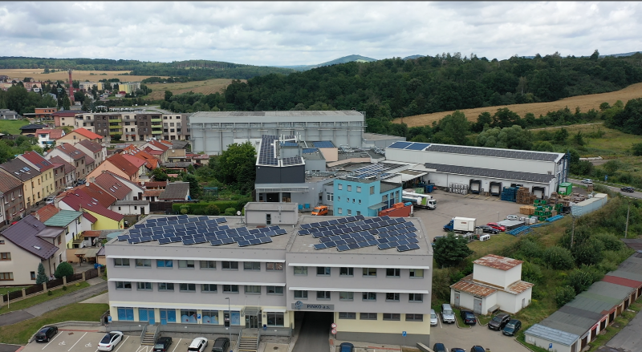
The search for optimal energy resilience was one of the main themes of the collaboration with PINKO, a manufacturer of frozen dairy products and ice cream. The site’s energy system was based on a standard configuration of core technologies for heat and cooling generation, supplemented by power generated from a photovoltaic power station. The required heat was provided by natural gas-fired sources, whilst cooling relied on electricity. The original brief aimed for the highest possible level of energy self-sufficiency and the ability to continue operations even in the event of a major supply disruption.
At first glance, such a requirement is understandable. Cooling is critical for this type of production, and any interruption could lead to the spoilage of both the produce and the stock. However, full energy self-sufficiency would require substantial investment, the economic benefits of which would not be commensurate with the probability or impact of all the scenarios under consideration.
The aim, therefore, was not independence at any cost, but a balanced approach. The proposal brought together two fundamental aspects: energy savings and increased operational resilience. We assessed the possibilities for the mutual utilisation of energy flows, the integration of renewable sources for direct consumption, the gradual modernisation of heating and cooling technologies, and the addition of a backup power source for those parts of the operation where an outage could cause the greatest damage.
The concept also anticipated that existing technologies would be replaced gradually as they reached the end of their natural service life. Safety features could thus be integrated into the system from the outset, without the need to immediately overhaul the entire energy management system. The proposed measures were also assessed in terms of return on investment, ensuring that the investment horizon did not exceed the expected lifespan of the technologies.
The original concept now also forms the basis for the next stage of PINKO’s development. The production site is set to expand its capacity, and the new energy solution is based on the principles established in the initial study. The concept has therefore not become a one-off outcome, but a framework for follow-up investments and the future shape of the entire operation.
REFERENCE PROJECT: Energy strategy and design of new energy sources for the PINKO production site
Safety as operational insurance
Not all measures aimed at energy security can be assessed in terms of standard return on investment. A backup power source or battery capacity set aside for a blackout functions much like insurance. A company does not acquire them primarily to make a profit, but to prevent a situation with significantly greater financial consequences.
Nevertheless, such safeguards need not represent merely an expense. A well-designed power source can reduce costs during normal operations, operate flexibly or generate additional income, whilst remaining available for a crisis situation. Economy and security therefore need not be mutually exclusive. The key is to set priorities correctly and not to exhaust the capacity intended to protect operations precisely when it is needed most.
The same principle applies to energy savings. The best energy is that which a company does not need to purchase at all. Every reduction in consumption limits dependence on the market, reduces the impact of price fluctuations and minimises the capacity of generation sources that need to be built or secured. Energy savings are therefore not merely an economic measure; they are also one of the fundamental elements of energy resilience.
Preparedness is more than just self-sufficiency
Events in recent years have shown that geopolitical and price fluctuations are not a thing of the past. They may affect a different commodity, a different part of the supply chain or a different type of operation, but the principle remains the same: the most vulnerable point is always the one on which an organisation is entirely dependent and for which it has no alternative in place.
Energy security is therefore not a state that a company achieves once and for all. It is an ongoing process of managing technology, investment and risk in line with changes in operations and the surrounding environment. It does not require having a dedicated solution for every conceivable scenario. It requires understanding the situations that could genuinely threaten production, assessing their impacts, and establishing a level of protection that is economically justifiable. The real advantage is not the ability to operate in isolation from the outside world. It is the readiness to keep running what the business truly depends on – even when energy is no longer a given.