

The energy sector has changed faster than ever in recent years. What used to function as a relatively stable and predictable system is now behaving like a dynamic market with significant fluctuations over time. For heating plants and industrial enterprises, this means a fundamental shift: the resulting economy is no longer determined solely by the efficiency of technology, but primarily by the ability to correctly time production and consumption. Whoever understands this change will gain a competitive advantage. Whoever overlooks it may incur losses even with technically flawless operations.
The old world of energy has ended. In the past, it was enough to have good technology, maintain stable operations, and choose between fixed or spot pricing once a year. Electricity was a relatively stable commodity, the difference between day and nite was clear, and any deviations could be endured without dramatic consequences. Operators could focus on their main craft—producing heat, running production lines, fulfilling orders—and energy was more of a necessary background than a strategic topic.But today, the energy sector behaves completely differently. And those who understand it in time can save significantly or even make a profit. Those who ignore it may encounter unnecessary losses even with technically perfect operations. Not because he was doing something wrong technologically, but because the world around him had changed.
A fundamental change has occurred primarily in the structure of electricity production and consumption. In recent years, renewable sources, especially photovoltaics, have dramatically increased, and conventional fossil fuels have been largely displaced. During the day, when the sun shines, a huge amount of electricity can flow into the grid, and its price drops sharply—sometimes even to zero, and in some cases, even into negative values. In the morning and evening, when people wake up, cook, shower, and industry starts up, and at the same time the sun is not shining yet or anymore, significant consumption peaks occur. It is precisely during these hours that electricity prices rise.The price of electricity is literally "taking off" today. The differences between cheap and expensive windows are not cosmetic, but fundamental. And more and more, they determine whether the operation runs economically well or poorly.
Quarter-hours that determine the outcome of the day
This change also includes another important detail with a huge practical impact. The electricity market is no longer evaluated by the hour, but by the quarter-hour. Each day is divided into 96 separately priced time slots. To a layperson, it might sound like a technical detail, but in reality, it's a fundamental shift.
If prices used to change hourly in the past, today they can change significantly even within a single quarter of an hour. This also reduces the ability to compensate for any deviations from the plan. Operations that run without planning or lack sufficient flexibility can buy or sell electricity very cheaply in one quarter-hour and very expensively just a few minutes later. This leads to differences on the bill that were almost non-existent before. What used to be diluted by the average now hits hard.
The price of electricity is not a number, but a process – and that is one of the biggest misunderstandings of contemporary energy. When someone says "electricity price," most people imagine a single number in crowns per megawatt-hour. But this simplification can be very dangerous. In fact, the economics of operation are often not determined by the electricity price itself, but by how it evolves over time, how accurately the operation aligns with its planned profile, and how well it can respond to market fluctuations.
Electricity is not a loaf of bread with a fixed price tag. It is a live market, where the price is constantly being formed – and where every inaccuracy is paid for. Electricity must be produced exactly when it is consumed. As soon as the plan and reality do not match, ČEPS must intervene using balancing energy. And the more strained the situation in the grid, the more expensive its balancing becomes. In extreme cases, a single poorly timed quarter-hour can undermine the economy of the entire day.
How the difference in timing changes results in practice
For heating plants and industrial enterprises, this reality has a very concrete impact. The operation can be technically top-notch, producing heat with high efficiency, having modern technology and experienced staff, and still be economically losing. It is enough for it to produce electricity when it is cheap and consume it when it is expensive. Or to fall into a deviation at the worst possible moment due to a slight shift or outage.
This is also related to the common misconception about fixed prices. A fix in reality does not mean certainty, but the transfer of responsibility for uncertainty to the supplier or trader. They must insure this uncertainty, and they will insure it with a price. The less predictable the operation, the more expensive the "certainty." So, one does not only pay for the electricity itself but also for the unpredictability of its own operation.
The difference between the statistical approach and market-driven management is well illustrated by the example of a modern heating plant with a cogeneration unit and heat storage. The traditional approach is based on history and averages. Slightly advanced operation is set to statistically typical advantageous morning and evening hours and runs consistently. On a specific analyzed day, this statistical approach generated approximately 30,000 crowns more from electricity sales compared to the usual operation controlled by heat demand.
However, when the same operation was planned according to the actual price forecast a day in advance and properly distributed over time, the potential yield was approximately 43,000 crowns higher. The difference of around forty thousand crowns occurred within a single day, without any changes in technology or investment in new equipment. It was only time and the method of management that made the difference.
The same principle applies in industry as well. Single-shift operations, which started production early in the morning, during the morning price peak, were able to significantly reduce costs by simply shifting the start of the shift by one to two hours. Savings in certain periods reached millions of crowns per month. Without investments, just by changing the organization of time.
In the new energy sector, the one who knows how to respond wins
At this point, most operations are asking the same question: who is supposed to do this? The heat plant produces heat, the industrial enterprise produces its product. Their role has always been based on operating technology, not on daily monitoring and evaluating the development of the energy market.And that's perfectly fine. The problem is that today technology and the market can no longer be separated. It's not enough to have a source or a consumer. It is necessary to be able to make decisions about its operation with regard to how the price of energy actually behaves throughout the day and to appropriately adjust the technology of energy production and storage accordingly.
ORGREZ TRADE was created precisely to connect these two worlds. Not by turning operators into energy traders, but by ensuring that trading is based on the reality of their operations. First, it is necessary to thoroughly understand the customer's profile, their capabilities, and limitations. Based on this, a plan is prepared for each specific day and specific quarter-hour. And subsequently, it is monitored to ensure that reality aligns as closely as possible with this plan – and if not, to be able to respond to changes.
And here we get to the very essence of the trading service. The fundamental prerequisite is not the exchange or trading platform, but the ability to predict and plan the behavior of specific operations as accurately as possible. The starting point is always consumption—whether it is electricity, heat, cooling, or another energy medium. A purely production power plant that generates only electricity and sends it to the grid without any connection to its own consumption or weather is rather an exception. Most real operations always have some internal energy demand or dependence on the weather that needs to be met as cheaply as possible.
In district heating, this typically means working with a combination of cogeneration units, electric boilers, heat pumps, heat storage, and possibly other sources. The point is not to produce as much as possible, but to produce when it makes economic sense. If the operation has storage, it can be utilized so that the cogeneration unit produces electricity during the hours when prices are highest, and the heat is stored in tanks. On the other hand, during hours when electricity is cheap—typically in the afternoon with high photovoltaic production—it may be more advantageous to produce heat using an electric boiler. In some situations, even using negative electricity prices.
The key is to understand the shape of the daily consumption and production curve and to be able to predict and balance it with at least reasonable accuracy. In district heating, heat accumulation significantly helps by allowing the separation of the moment of electricity production from the moment of heat delivery. Thanks to this, it is possible to very precisely control when the cogeneration unit starts up, when it shuts down, and when another source takes over. The operation then knows a day in advance how it will function energetically, and trading can directly follow this plan.
In industrial enterprises, where it typically concerns "only" consumption, the principle is similar, just simpler. The key here is the agreement on when the energy-intensive technologies will actually be in operation. If the operation knows when it will start up and shut down energy-intensive technologies—such as furnaces, dryers, or other high-performance appliances—and can adhere to this schedule, it creates the fundamental prerequisite for successful trading. Once the operational regime is stable and confirmed, the energy trader can work with it and significantly reduce the risk premium in the price. Conversely, if the start-up and shut-down times are constantly changing and are unpredictable, this uncertainty must necessarily be reflected in the price.
When operations meet market reality
The difference between these two approaches is fundamental. A clearly defined framework between operations and trading regarding what the daily consumption or production profile will look like paves the way for effective management of costs and revenues related to the purchase and sale of electricity. Therefore, ORGREZ TRADE works with a direct connection to the customer's operational management. Thru its own ENEXA system and ORGBOX terminal, it is possible to connect directly to the operation control system. Trading thus sees real-time actual consumption and production, the status of storage tanks, or the performance of individual technologies and compares them with the plan.
This approach allows not only for planning a day in advance but also for ongoing monitoring and real-time response. Operations also have an overview of how much they deviate from the agreed regime and what economic impact this has. Trading is thus not a separate "exchange" function, but a natural extension of operational management. The result is higher accuracy, lower deviations, and better utilization of flexible resources – especially cogeneration units, which today represent one of the key tools for working with time to one's advantage in the new energy sector.
It's actually simple. In the new world of energy, it is no longer enough to be just a good producer. Energy today is not just a matter of technology, but primarily about working with time and uncertainty. It is no longer enough to produce or consume energy efficiently – it is increasingly important to understand when this happens and what impact it has on the economics of operation. What used to work automatically now requires thoughtful, often very quick decision-making and better integration of operations with market realities. Even a small change in the timing of production or consumption can have a greater impact than another percentage point of technology efficiency. And therein lies the difference between an operation that merely reacts to bills and one that truly understands its energy consumption.
Sample day: how the right timing changes the result of the operation
An example of a typical day when operations are managed mainly according to historical averages and fixed time blocks. Individual heat sources are activated at predetermined intervals without a deeper connection to the current situation in the electricity market.
The graph clearly shows that while the heat demand is technically covered, the electricity production from the cogeneration unit does not always occur at the times when it is most needed. Heat accumulation is only partially utilized, and operational flexibility remains largely untapped. The result is a lower overall benefit from electricity sales and poorer utilization of the technology's potential.

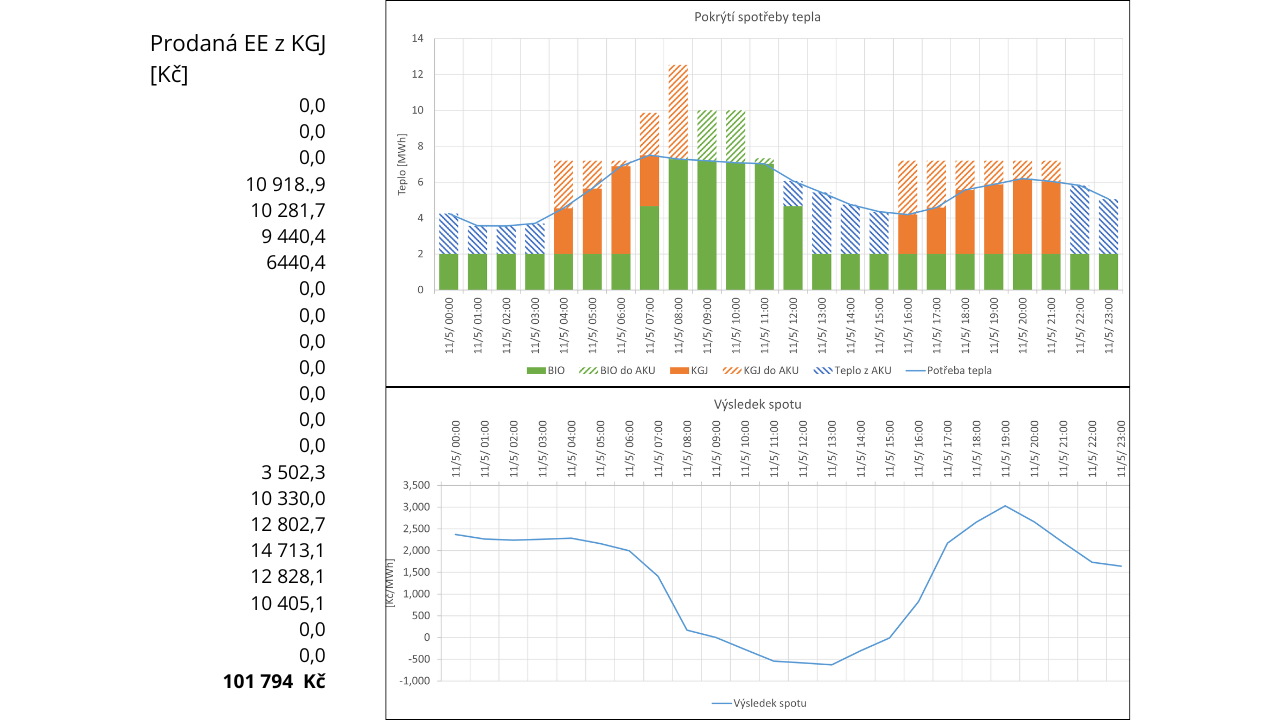
The same day while managing operations based on spot price predictions and quarter-hourly planning.
The upper part of the graph shows the comparison of the actual development of spot electricity prices with their prediction. The lower part then illustrates how the deployment of individual sources changes based on this prediction. The cogeneration unit primarily produces electricity during the hours with the highest prices, while heat production is balanced thru accumulation. In cheaper hours, it is more advantageous to produce heat in another way or to recharge the storage.
The difference between the two approaches does not arise from a change in technology, but from a different decision about operating time. It is precisely this
shift – from static management to daily market-based planning – that forms the foundation of trading services in practice.
BIO – biomass boiler output
KGJ – performance of the cogeneration unitHeat from
AKU – performance of the accumulator tank discharge
Heat to AKU from BIO – performance of charging the storage tank from the biomass boiler
Heat to AKU from CHP – performance of charging the accumulation tank from the combined heat and power unit
You can find more about our service at: https://www.orgreztrade.cz/