
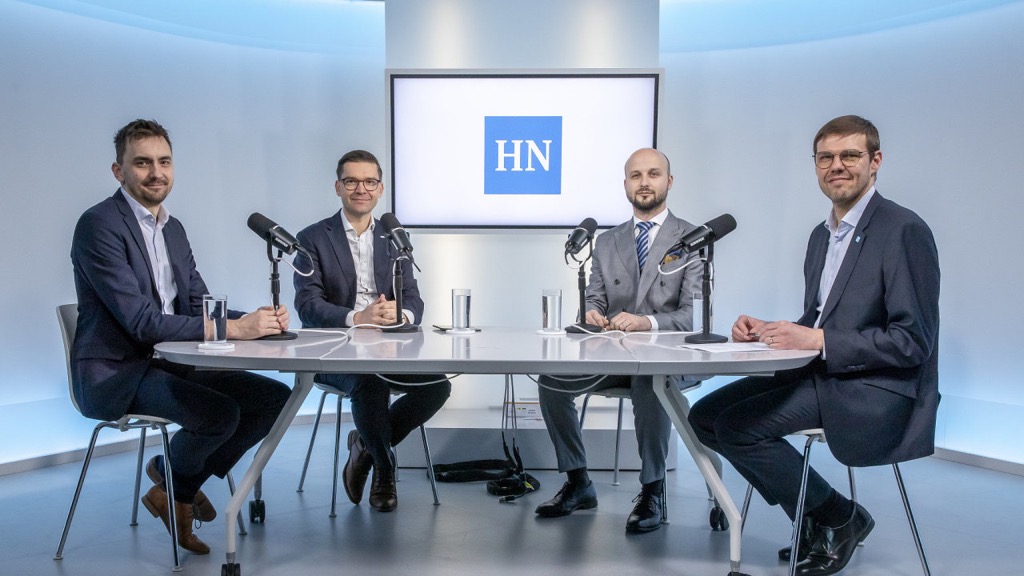
"We need to install smart meters so that we know what is happening in the grid and can also look at the grid as a whole. At some point, a problem will arise: there will be enough energy, but it will not be in the right place, because the time frame for building new sources such as photovoltaics, batteries, and the like is completely different from that for linear structures, such as power distribution systems. We can already see that the system is really reaching its limits," said Jan Krišpín, CEO of ORGREZ, in a discussion in Hospodářské noviny at the beginning of January. "We have a problem with old 'iron'; the wires were dimensioned from the largest sources, i.e., coal and nuclear power plants, to consumers. If energy is now being produced in many places, digitization is all the more necessary. Not only so that we know how to manage energy, but also how to plan it," Krišpín pointed out. According to Lukáš Dobeš, director of Tedom ESCO, investments in the transmission system and data from smart meters are also needed. "We need to know exactly how prosumers behave, i.e., those who consume at certain times and produce at others. Some of them even have batteries. These consumption patterns are invisible to us today. As energy suppliers, we have no idea what is going on behind the meter," Dobeš pointed out.
Companies themselves invest in smart meters
Daniel Szántai, founder of Terraverse, noted that it is possible to distinguish the level of digitization in the private sphere, which is driven not by regulation but by market forces. "Some companies are willing to invest in smart meters simply to have a better overview of consumption, perhaps lower deviation costs, and to be able to influence production and consumption over time. In fact, they are ahead of the development of smart meters," Szántai pointed out. Lukáš Dobeš gave a specific example of the symbiosis of several energy sources in the debate. The heating plant in Slavičín in the Zlín region is a multi-source energy center that initially had a gas boiler, to which two cogeneration units, biomass boilers, heat pumps, and photovoltaics were later added. "Today, it is a system that combines a large number of sources and needs to work with data and predictions of what the weather will be like in the coming days, as well as heat and electricity consumption. In this case, data is absolutely essential for the system to function economically and ensure a return on investment," noted Dobeš. Jan Krišpín demonstrated the importance of data on energy flows in the heating industry. "Based on data that is already available from public sources—the land registry, statistical office, and the like—we are able to describe the entire project, how the heating industry should develop in the future. For example, the decarbonization plan, the urban development plan, and the construction of distribution networks," Krišpín mentioned. Knowing the exact data on what is happening in the energy network could also lead to companies adapting their operations, or rather their production planning, to the energy sector.
Digitization can reduce energy costs
The participants also discussed whether digitization can lead to lower energy prices. "I would not expect a reduction in the price of electricity, but it could benefit households in other areas of energy costs. For end users, it could lead to a decrease in the price of system services. If energy companies are able to measure households effectively, they can charge a smaller surcharge for deviation costs (the difference between ordered and consumed electricity – ed.)," Szántai suggested. According to experts, the purchase of smart meters is also worthwhile for smaller households with lower consumption. "Everyone should have smart meters. Even small households can adapt to this. Take, for example, households where someone is usually at home during the working day – seniors or parents caring for children. By being at home at noon, they can make a significant profit on this system," said Dobeš. They can shift their energy needs to the hours between 12 and 2 p.m., when electricity is cheapest.
Network management will increasingly depend on data
The discussion also touched on the question of whether digitization of the energy network can prevent blackouts. Jan Krišpín described the situation that arose with the advent of photovoltaics on the roofs of Czech households and businesses. "When clouds pass across the sky, the country literally flashes like a Christmas tree. At one moment, energy flows in one direction, then it flows back again, causing sudden changes in power throughout the distribution and transmission system," said Krišpín. Especially in the summer months, certain parts of the system must be disconnected in a controlled manner to relieve the load. "Managing this depends more and more on data. And all equipment will also have to be dimensioned for the high dynamics that occur in the system. This problem has not existed historically, but it is emerging worldwide. We have no models at all for what will happen in the system," Krišpín fears. Daniel Szántai pointed out that Czechia has a specific feature compared to Western Europe, namely a very strong central heat supply. "Heating is the only segment that can now truly and effectively use flexibility as a secondary product. We don't necessarily have to go down the path of installing new technologies, but rather adapt flexibility with an emphasis on heating," added Szántai. Heating plants are capable of accumulating large amounts of heat, i.e., energy.
You can listen to the entire interview in the podcast version or watch it on YouTube.