
The article appeared in the magazine *Moderní obec* on 8 September 2026
Some of the data is held by building managers, some by technical departments and designers, and some is generated as part of audits and conceptual studies. Added to this are data from network operators, financial investment plans and documentation for spatial planning. The problem, however, is not that this data is lacking. It is that it is fragmented and rarely linked in such a way as to form a single, comprehensible basis for decision-making.
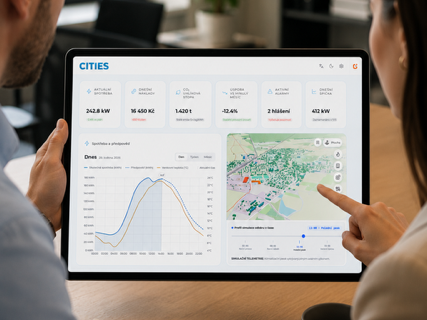
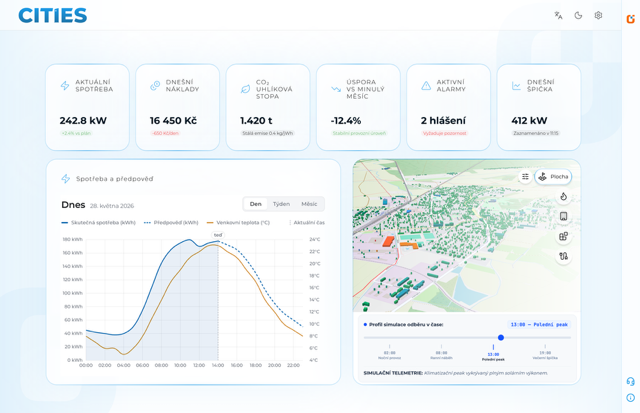
The ORGREZIO Cities platform addresses precisely this problem. It brings together information on buildings, their technical and energy status, mandatory documentation and development plans into a single environment, within which the user can view the city and its energy system as a single, interconnected whole. The aim is to shift investment planning, budget allocation decisions and the management of mandatory documents away from the tedious work of dealing with fragmented spreadsheets towards a clearer and continuously updated format.
However, for such a tool to be of genuine use to a local authority, it must be fed with data. And it is precisely the way in which this data is fed into the system that often determines whether the local authority will actually use it, or whether it will remain yet another unused document.
Start without an empty table
One of the reasons why such tools often end up unused in towns and cities is that they are difficult to get started with. If a council official or building manager has to manually enter dozens of parameters for each building, their motivation quickly wanes.
ORGREZIO Cities therefore utilises an initial data import from publicly available databases during implementation. This means the local authority does not have to enter basic information about buildings, their locations and recorded parameters manually from scratch. The system starts with a pre-populated map, which it can then build upon, rather than beginning with a blank spreadsheet.
Legal documents as a source of data, not a burden
Local authorities and the buildings they manage have a number of legal obligations. These include energy performance certificates, energy audits and building surveys. These documents are produced on a regular basis and contain valuable data, but in practice they end up being stored as separate PDF files without being put to any further use.
Jan Huml, Director of ORGREZ DATA, describes the technical aspects of this integration: “Data from these documents is entered into the system either automatically or with assistance, so that the local authority or energy specialist preparing the audit or inventory not only submits the document, but also uses its content to enhance the overall overview of the local authority’s assets.”
This step changes the nature of the mandatory documents. Rather than being one-off outputs that merely comply with the letter of the law and are then filed away, they become ongoing inputs into a single, dynamic model of the city.
From a one-off concept to a living tool
This is precisely where the difference lies compared with traditional local energy plans, which tend to be static documents describing the situation at the time of drafting and are subsequently updated only rarely, if at all.
Jan Hanus, Director of ORGREZ ECO, describes this principle using the example of an energy audit, which is often the initial impetus for many local authorities to start working systematically with data: “We see the audit as a cornerstone. It enables us to fulfil our legal obligation, but we also take the opportunity to collect data in a standardised way and add our own individual approach – a specific path to savings and modernisation.”
When this logic is applied within the ORGREZIO Cities environment, the output is no longer just a one-off document, but an ever-updating picture of how the local authority’s assets are changing.
“In practice, this means that the council’s decisions on prioritising investments, planning repairs or applying for grants are not based on data that is several years old, but on the current situation. And for officials or building managers, this means less manual administrative work, as much of the work is handled by data integration – data that would have to be compiled anyway to meet legal obligations,” adds Jan Hanus.
As a result, the local authority not only gains a clearer overview of its records, but also a tool that saves it time and money in the long term and enables it to make decisions based on the current situation and needs, rather than outdated data. If your local authority is also looking for a way to bring order to its fragmented energy data, we’d be happy to show you how ORGREZIO Cities works in practice.