

From a Legal Requirement to an Operational Necessity
Historically, automated measurement systems (AMS) were designed primarily to meet the requirements of emissions legislation. The main focus was on measurement accuracy, data validation, and data archiving for the purpose of regular reporting to regulatory authorities. In many facilities, emission monitoring systems remained separate from the actual control of the technology, and their data was used only retrospectively, often only when evaluating emission balances.
“Until relatively recently, emissions monitoring was viewed mainly as a necessary obligation. We often encountered situations where the data existed, but was not actually used for further analysis,” says Ondřej Baron from ORGREZ’s Air Protection Technology Division.
However, with the growing complexity of technological processes, the variability of fuels and raw materials, and increasingly stringent emission limits, this approach is proving unsustainable in the long term. Modern operations require fast, reliable, and interpretable feedback on the current state of the technology and the ability to respond in a timely manner to emerging deviations before the process becomes unstable or emission limits are exceeded.
Emissions as Process Information
From the perspective of chemical and process engineering, emission parameters cannot be viewed solely as environmental indicators. Concentrations of nitrogen oxides (NOₓ), carbon monoxide (CO), sulfur dioxide (SO₂), ammonia (NH₃), or oxygen (O₂) directly reflect the course of chemical reactions, local stoichiometry, temperature distribution, and the homogeneity of mixing of the reacting components.
“A change in emission values is very often the first sign that something is happening in the technology—whether due to a change in fuel, raw material quality, or equipment operating settings,” notes Ing. Tomáš Krejčí, director of EVECO Brno.
Emissions data thus provide an indirect but highly sensitive picture of the chemical state of the process. In many cases, they can signal an emerging problem sooner than conventional process sensors for pressure, temperature, or flow, making them a valuable tool for predictive process control.
AMS as a Source of Operational Data
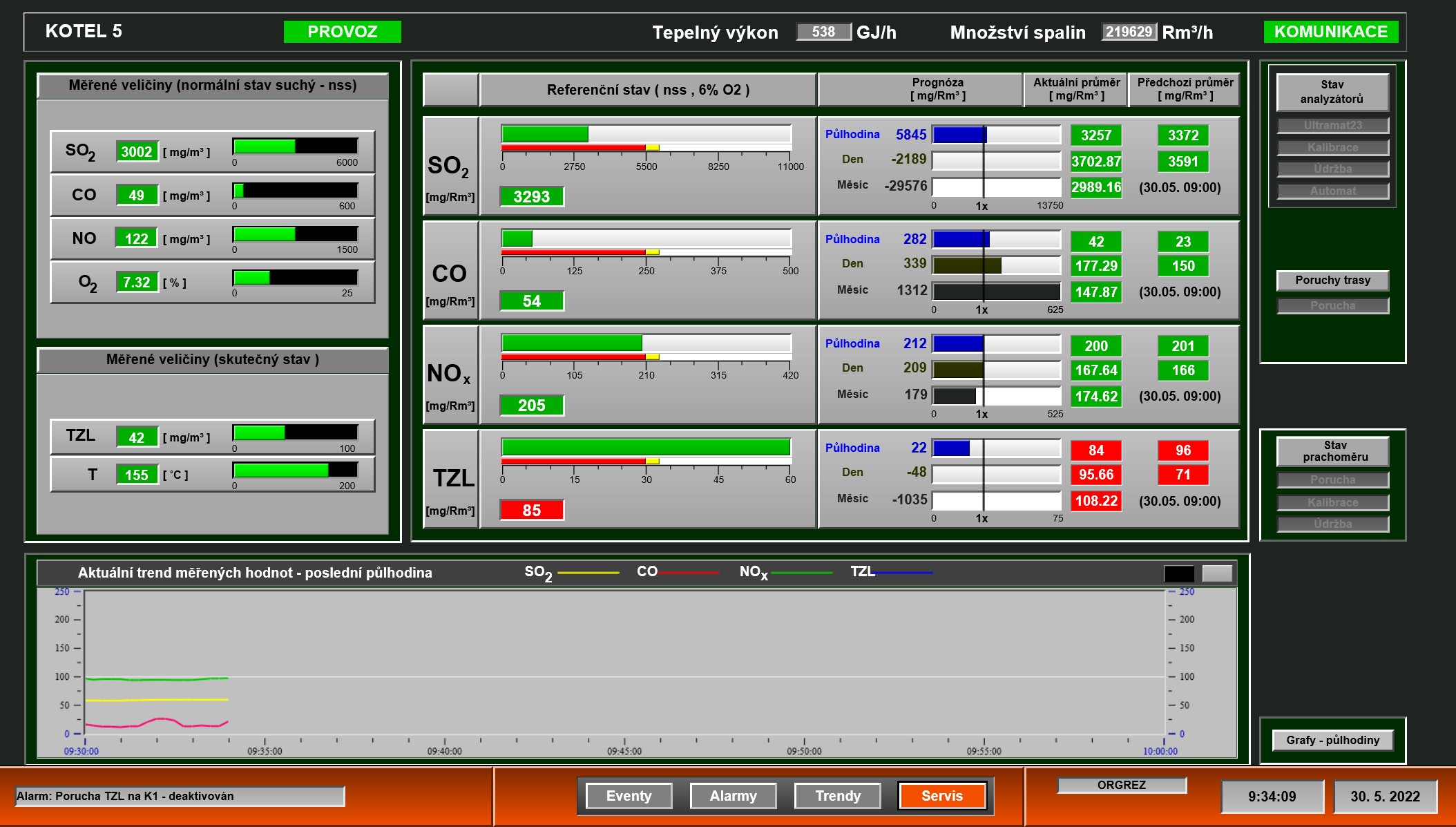
Continuous emission monitoring (AMS) today typically includes monitoring of concentrations of NOx, SO₂, CO, particulate matter (PM), NH₃, and O₂. However, the added value of this data only emerges when it is systematically utilized as a full-fledged source of operational information.
“We distinguish between monitoring for regulatory compliance and monitoring for operations. Only the latter gives emission data real meaning and allows us to actively work with it,” states Ing. Tomáš Bortlíček, an ORGREZ technician responsible for AMS operations.
In practice, however, it is necessary to distinguish between parameters suitable for direct process control and those for which the AMS primarily serves a reference or validation function. A typical example is the concentration of CO and O₂, which are often measured for dynamic combustion control using faster online analyzers located closer to the process source, while the AMS provides long-term stable and legally relevant data.
Integrating Measurement and Technology as the Key to Efficiency
Modern flue gas cleaning technologies are sensitive to operating conditions, and their efficiency is closely tied to the quality of the input data. In practice, however, we still encounter situations where the technology and the measurement system are designed separately, leading to scenarios where the technology operates without adequate feedback. Ultimately, this can negatively impact operational economics.
A typical example is selective catalytic reduction (SCR) or non-catalytic reduction (SNCR) of nitrogen oxides, where insufficiently controlled dosing leads to the formation of so-called ammonia slip, catalyst fouling, and the associated reduction in reaction area, while simultaneously increasing operating costs.
“Accurate and stable measurement is absolutely essential for the proper control of technologies such as SCR. Without high-quality and correctly interpreted data, the process cannot be optimized in the long term,” emphasizes Ing. Tomáš Krejčí.
Inaccurate measurement of SO₂ concentrations has similar impacts in desulfurization technologies, where inaccurate data directly affects sorbent consumption, utilization of reaction potential, and the stability of operation itself.
Reliability, Maintenance, and Emissions Reporting
Emissions monitoring is a dynamic technical system whose reliability depends on regular maintenance, calibrations, and ongoing diagnostics. Shortcomings in the design of sampling points, underestimation of operating conditions, or a lack of integration with process control systems can significantly reduce the reliability of the measured data.
“Because we know the system from design through to day-to-day operation, we can quickly determine whether a problem is a measurement error or an actual change in the technological status,” says Libor Maňák, Director of the Air Protection Technology Division at ORGREZ.
Since data from AMS systems is, in most cases, automatically reported to regulatory authorities, its availability and accuracy are critical. Any outage, measurement drift, or data inconsistency can have an immediate impact on operations as well as on relationships with regulatory authorities and the public. For this reason, a model of continuous support—service contracts, remote monitoring, and a dedicated hotline for measurement and diagnostics—is becoming increasingly prevalent. The ability to quickly identify a problem and correctly interpret data is thus becoming a critical part of operations.
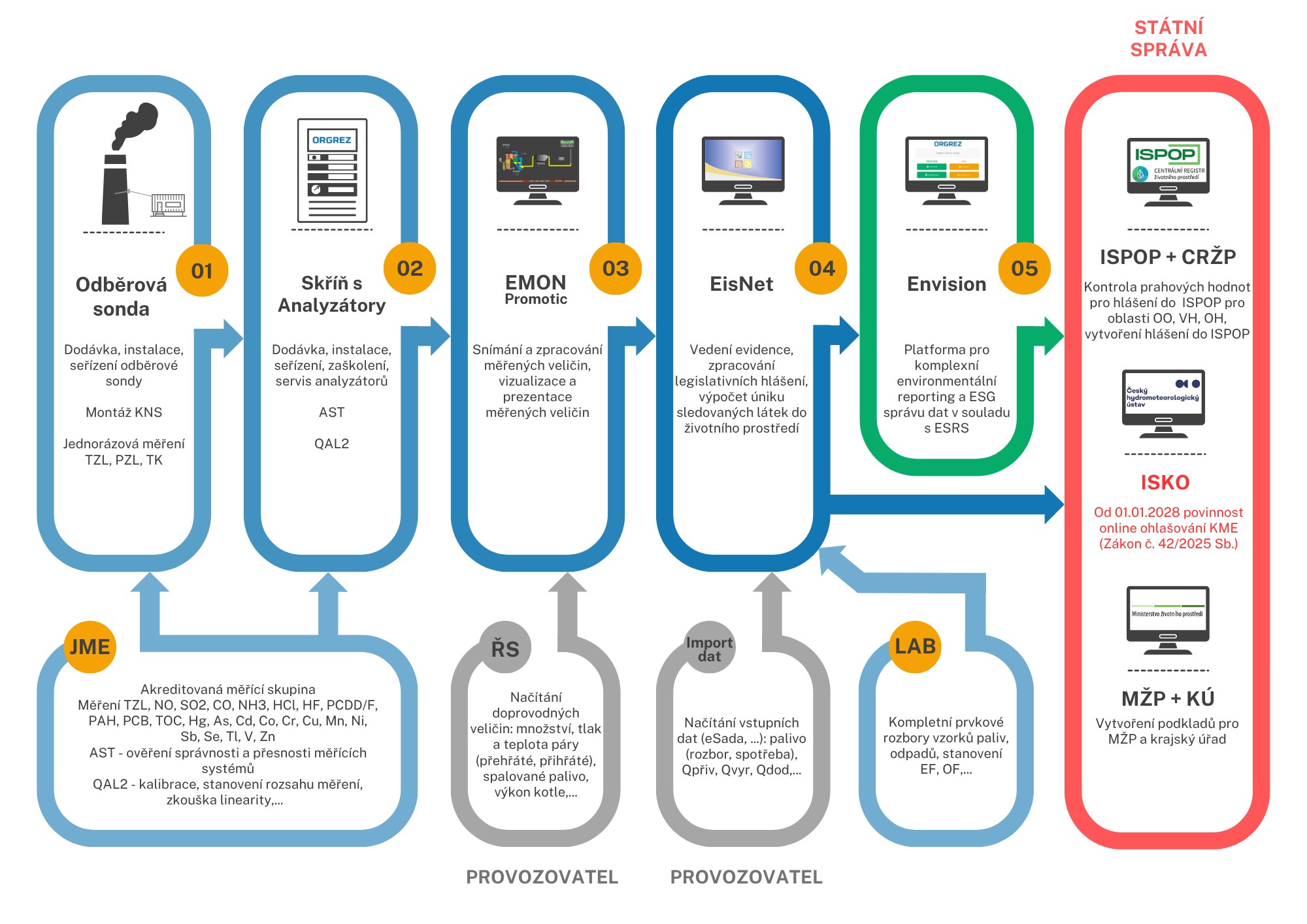
Within the ORGREZ Group, this area is addressed comprehensively—from the design of monitoring plans and the implementation of methodologies to the actual preparation of emissions reports and communication with the relevant authorities. Data consistency between process control and official reporting is key.
CO₂ Emissions and Economic Implications
The importance of emissions monitoring is further heightened by the requirements for tracking and reporting CO₂ emissions under the EU ETS. Measurement accuracy and properly established methodologies directly impact the reported emissions figures and, consequently, the facility’s overall operating costs. In practice, both continuous CO₂ measurements and calculation methods based on fuel balance are used. A key aspect here is the consistency of data between operational management and official emissions reporting.
Within the ORGREZ Group, this issue is addressed comprehensively—from the design of monitoring plans through the implementation of methodologies to the actual preparation of emissions reports and communication with the relevant authorities. Operational experience confirms that the greatest risk is not the measurement itself, but the discrepancy between the data used for technology control and the data reported for regulatory purposes.
Measurement Reliability and Long-Term Monitoring
Emissions monitoring is a dynamic technical system whose reliability depends on regular maintenance and ongoing diagnostics. That is why a model of continuous technical support is becoming increasingly prevalent.
“Any measurement drift or failure today has an immediate impact—not only on the operation of the technology but also on regulatory reporting. That is why regular servicing and remote monitoring of the AMS are important,” explains Jiří Šimeček, lead technician in the ORGREZ service department responsible for AMS servicing.
Operational Experience and Future Development Directions
Practical implementations confirm the universal benefits of properly integrated emissions monitoring. In biomass heating plants, the use of emissions data enables the optimization of combustion and a reduction in the consumption of auxiliary agents. In medical waste incinerators, it helps manage significantly variable fuel composition while maintaining stable operation. The medical waste incinerators in Hradec Králové and Benešov are examples of facilities where AMS is fully integrated into the modernized process control system.
In the chemical and petrochemical industries, the importance of not only reducing emissions but also implementing measurement systems and linking them directly to reporting and environmental management is currently growing. This trend is driven by both stricter emission limits and increasing pressure for data transparency. Future developments in emissions monitoring are moving toward deeper integration into control systems, data digitization, the use of predictive methods, and automated diagnostics. Emissions monitoring is thus becoming a key element of technological process control, with its primary benefit lying in the effective use of the data obtained.
You can find more information about ORGREZ Group’s services for the chemical and petrochemical industries on this page.