

The answer is not to let assets run until they fail, but to manage their continued operation based on data. Timely diagnostics can help buy time to prepare for a replacement and direct limited capital where it is truly needed.
Article published in the professional journal Energetika, issue 5/2026
The energy transition presents an apparent paradox: total energy consumption may be falling, while the importance of electricity is growing. According to NECP WAM / ČEPS MAF scenarios, the Czech Republic expects a decrease in final consumption of all energy from approximately 280 to 250 TWh between 2023 and 2040. This decline is primarily driven by the electrification of industry and transport. At the same time, however, the share of electricity in this consumption is rising from 58 to 87 TWh, or from 21% to 35%. I will disappoint skeptics of such long-term forecasts—it is not essential whether this scenario hits the exact TWh figure; the principle is what matters: a more efficient economy does not mean lower demands on electrical grids. Quite the opposite.
A more efficient economy needs a stronger electrical infrastructure
The scale of the investment task facing not only the Czech energy sector is illustrated by a 2024 Deloitte study. For the transmission and distribution system, it cites expected investments of nearly 476 billion CZK between 2024 and 2035, in 2023 prices. The average of 39.6 billion per year represents a 38 percent increase compared to the 2010–2023 period. Unfortunately, this study was released before the negotiations for the 6th regulatory period were concluded, which resulted in a reduction of the expected volume of investments by 2030 in distributors' investment plans. The overall investment ambition remains unchanged; the investment boom is still ahead for the Czech economy. And watch out for the details—even a growing budget does not automatically solve targeted renewal: today, investments in customer connections, grid reinforcement, metering, and digitalization are all fighting for the same money.
On the other side of the purchasing table, pressure on production capacity is mounting. In a 2025 report, the IEA notes an approximately 75% increase in the price of power transformers compared to 2019, with lead times for large power transformers reaching up to four years. This is not a universal price list or a deadline for every distribution transformer; rather, it is a fact that an approved budget alone does not guarantee timely replacement. Meanwhile, manufacturers are gradually expanding production capacity, but until then, infrastructure owners are dependent on timely and precise planning combined with a detailed maintenance schedule. What is missing from the IEA report is the sad reality of Western Europe's "sharp elbows" (I intentionally avoid the term "Czech small-mindedness," which I deeply despise), which fully manifested itself in the prioritization of transformer deliveries during the shift away from the SF6 insulating medium. It is good to at least be aware of this phenomenon and learn to account for it in an era of a fragmented global market.
At the same time, the financial situation of individual operators varies. Managing an extensive investment program while accounting for the connection of distributed generation presents the same risks as a conservative investment plan for an industrial enterprise. Both are addressing a practical question: how much money should be allocated to new production and how much to the infrastructure without which production cannot run? Without the certainty of long-term contracts and secured supplies, it is reasonable to begin preparing for renewal before an acute need even arises.
The grid will eventually collect its due
Let us pause to consider grid renewal, whether public or private. The physical condition of equipment is not governed by an approved budget. An unresolved problem will (in the best-case scenario) return as a malfunction, supply restriction, or production outage. The costs of grid maintenance and operation are then reflected in the customer's energy bills; in industry, these impacts manifest in production results. However, the bill does not have to end up only in the wallets of consumers and customers; it can also land on the board of directors' table—a cheaper investment plan is no victory if reliability is the price paid for it.
The answer, however, is not blanket replacement based on the established economic-regulatory mantra derived from linear equipment lifespans and depreciation. Large distributors are already managing asset renewal through a combination of risk and TCO/LCA/TOTEX approaches; there is no revolution here. The challenge, however, is to develop and maintain these methodologies according to the changing nature of operations and the importance of assets in the grid, and to make the necessary data accessible to smaller, private infrastructure owners as well. The key question is not just "how old is the equipment," but "what is its condition, what will it have to handle, and what would be the consequences of its failure?"
Managed end-of-life therefore does not mean waiting for a breakdown.
It means conditional continued operation: with defined loads, targeted care, monitoring of developments, and a prepared replacement. If technical or economic assessment does not justify further operation, the correct result of the diagnostics is, conversely, timely replacement. The goal is not to extend the life of every piece of equipment, but to decide where continued operation has value and where it creates an unreasonable risk.
This approach also has European support. The Grids for Speed study models a reduction in the average annual investment requirement for distribution networks in the EU and Norway between 2025 and 2050 from 67 to 55 billion euros by combining early investment, better asset management, and the use of flexibility, showing that the solution lies not only in more new equipment but also in better utilization of existing assets.


Diagnostics must end with a decision, not a report
At ORGREZ, we combine expert laboratory diagnostics, electrical measurements, and technical interventions. For us, the foundation is a view of the entire device and its comprehensive assessment, not just one compliant parameter. Regular monitoring of the insulation system in the context of operational history allows us to assess its condition, propose measures, and professionally estimate further operational reliability or service life.
For a human, a blood count and genetics provide a report card on quality of life and organ health. For oil-filled transformers, the oil itself tells us how the "orchestra" of components inside the transformer is performing and what condition it is in. Dissolved Gas Analysis (DGA) helps diagnose processes inside the device: water content, acidity, breakdown voltage, or dissipation factor complete the picture of the oil's properties, and, for example, furanic compounds released from paper insulation tell us the state of the paper insulation inside the machine.
Let’s stick with colorful analogies for a moment. If oil analysis is the recording, then subsequent diagnostics and electrical measurements are the sharp, precise smash that follows. Diagnostics such as winding resistance, turns ratio, insulation resistance, capacitance and dissipation factor, or assessments of frequency response analysis (FRA), dielectric spectroscopy, and bushing or tap-changer diagnostics—all based on the clues provided by the oil analysis.
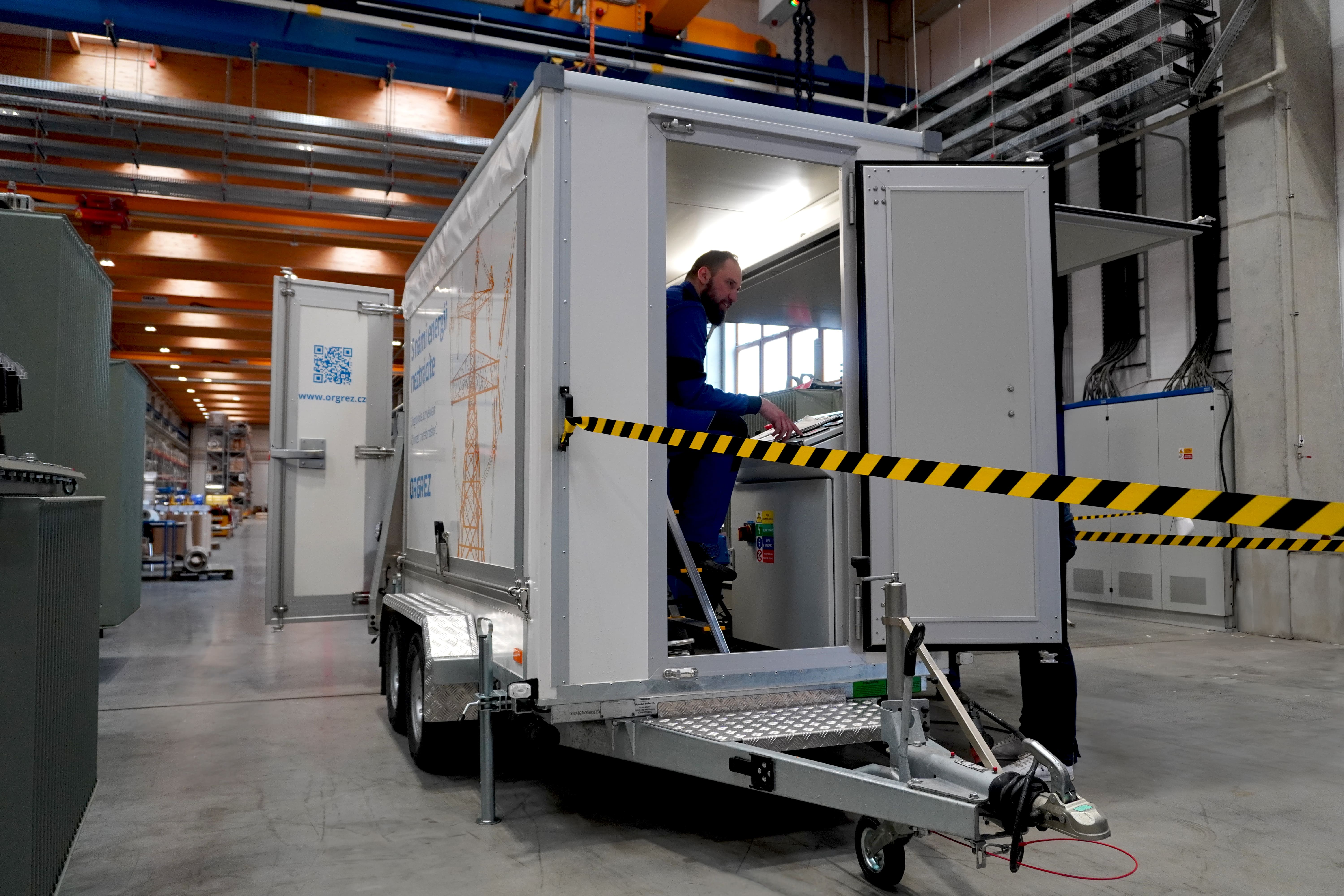
The technical aspect must then be combined with economics. Our mobile measuring unit, EMTRA, allows ORGREZ to obtain data on losses and operating parameters for customers with smaller distribution transformers. In addition to the purchase price of a new machine, the final economic assessment includes future losses, maintenance, interventions, downtime, and risks. Beyond Total Cost of Ownership (TCO), we are also able to work with environmental Life Cycle Assessment (LCA).
The point is not to perform as many tests as possible, but to obtain a basis for the next step; the output is not just a report for the drawer, but primarily a foundation for management decisions.
We know what lies ahead for your infrastructure
Measurement alone does not extend service life; the benefit only arises from the decision and the corresponding measures taken. Connecting laboratory testing and electrical measurement into actionable steps takes a concrete form. For Extrusions Děčín, ORGREZ developed a diagnostic monitoring methodology for power, distribution, and furnace transformers, which was also extended to instrument transformers. The measurement reports include expert assessments and recommendations for continued operation. The value for the customer? Not just a test result, but its translation into an operational decision—precisely targeted asset management.
To make decisions about the future of equipment, we must also know what is happening in the energy ecosystem. The importance of future grid load, including and especially that of the transformer, is growing. If we look at model transformer load graphs in traditional versus new energy systems, it is evident that the same annual consumption does not necessarily mean the same peaks. An example is the coincidence of market and grid price signals: if a larger number of devices react to them simultaneously, the load can shift to a different critical period or create a new local peak. For a transformer, this means higher stress and a higher risk of failure.
Questions regarding the impact and coordination of grid management tools, such as dynamic tariffs and non-frequency services, modeled on specific MV and HV grid topologies, are currently moving to the forefront of interest for individual players in the energy market.
Conclusion
While diagnostics today cannot replace investments that are technically necessary, they fundamentally help determine their urgency and justify a safe postponement where it makes sense. The value of a deferred investment is less immediate pressure on CAPEX and more time to prepare for a replacement.
The goal of maintaining energy equipment is not maximum service life. The goal is reliable service and replacement at the right time. We will not build the new energy landscape solely from new equipment, but also by maintaining the assets entrusted to our care by our energy-sector predecessors.
Author: Petr Lang, Sales Director for Power Engineering, ORGREZ, a.s.