
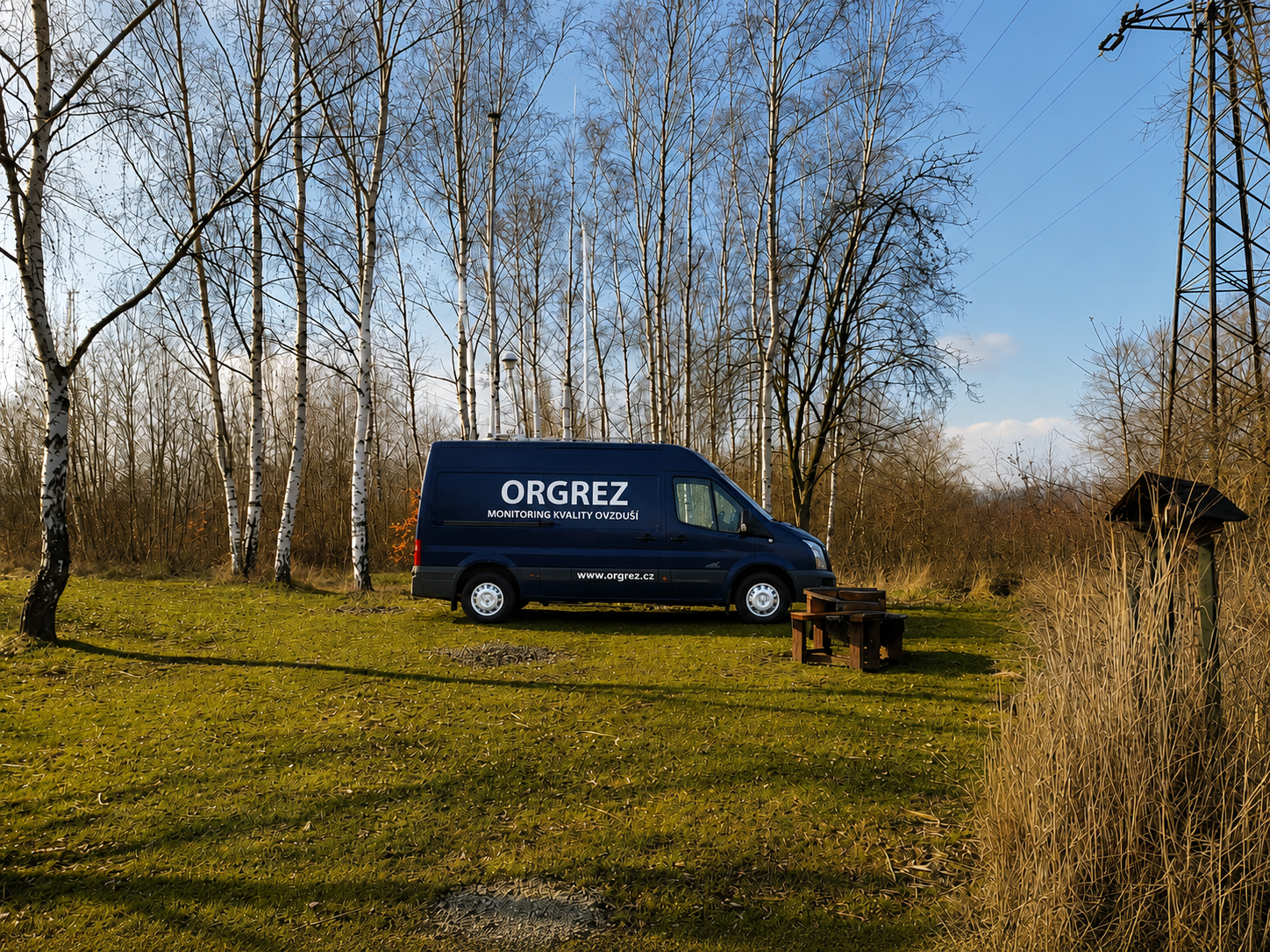
At ORGREZ, we therefore view air pollution monitoring as part of a comprehensive assessment of environmental quality – from the design of monitoring and field measurements, through data validation, to the expert interpretation of the results.
Customers most often turn to us when they need to obtain objective information about air quality in a specific location. This may be in connection with the planning or expansion of industrial operations, the assessment of the environmental impact of construction projects, compliance with legislative requirements, or the verification of the impact of operations on the surrounding environment.
A key area is the long-term monitoring of air pollution from large energy sources, where we manage the operation of an entire network of automatic monitoring stations and provide expert analysis of the results. In addition, we carry out dust measurements at large-scale outdoor sites, such as bulk material storage yards (VEP), where clients need to demonstrate the effectiveness of dust control measures or compliance with the requirements of air quality authorities.
Air quality monitoring is also important during the construction and modernisation of linear infrastructure. The data collected is used to assess the impact of traffic on air quality and as a basis for preparing the relevant documentation.
When atmospheric data is incorporated into the design of a technology
A specific area of our services involves specialised measurements of outdoor air quality for the design of filtration systems for industrial plant. Based on the measured air pollution data, we determine the input parameters for the design of filtration systems for data centres, combined cycle power stations and other industrial units, the reliability and service life of which are directly dependent on the quality of the intake air. The measurement results are therefore not merely a description of air quality; they form an important basis for the design and optimisation of technical solutions.
According to Vojtěch Kopřiva, Director of the Air Pollution and Fuel Control Division at ORGREZ, it is precisely this broader perspective on the measured data for the service as a whole that is crucial: “We view air quality monitoring as part of a comprehensive assessment of environmental quality. Our aim is not merely to measure concentrations of pollutants, but to provide customers with objective, independent and scientifically sound information to assist them with permitting processes, the operation of industrial facilities and the design of modern technological systems.”
From air quality to a broader view of the environment
Another key area is monitoring in the vicinity of waste-to-energy plants (ZEVO). Our work does not end with air quality monitoring alone. We also carry out accredited measurements of mercury (Hg) in the air, collect aerosol samples to analyse for heavy metals, and undertake other related environmental sampling.
Depending on the nature of the project, monitoring may include, for example, soil sampling to determine levels of mercury (Hg), polychlorinated dibenzo-p-dioxins and dibenzofurans (PCDD/F) or polycyclic aromatic hydrocarbons (PAHs). This enables the client to obtain more comprehensive information within a single project, not only on air quality but also on other environmental components.
We can also supplement the measurements with air pollution modelling. This enables us to assess the dispersion of pollutants, evaluate various operational scenarios and provide a technical basis for the preparation of investment plans or permit applications.
How air pollution monitoring works in practice
Every project begins with an analysis of the client’s needs. There is no single, universal measurement method that would suit every location and every purpose. We therefore design a monitoring strategy based on the specific requirements, select the optimal location and scope of measurement, identify the pollutants to be monitored, and choose the appropriate measurement technology.
Then comes the work in the field. ORGREZ technicians install the monitoring systems, calibrate them and manage the monitoring operations themselves. For operational monitoring campaigns, we also have our own mobile monitoring vehicle, which enables us to carry out monitoring directly at the location specified by the client.
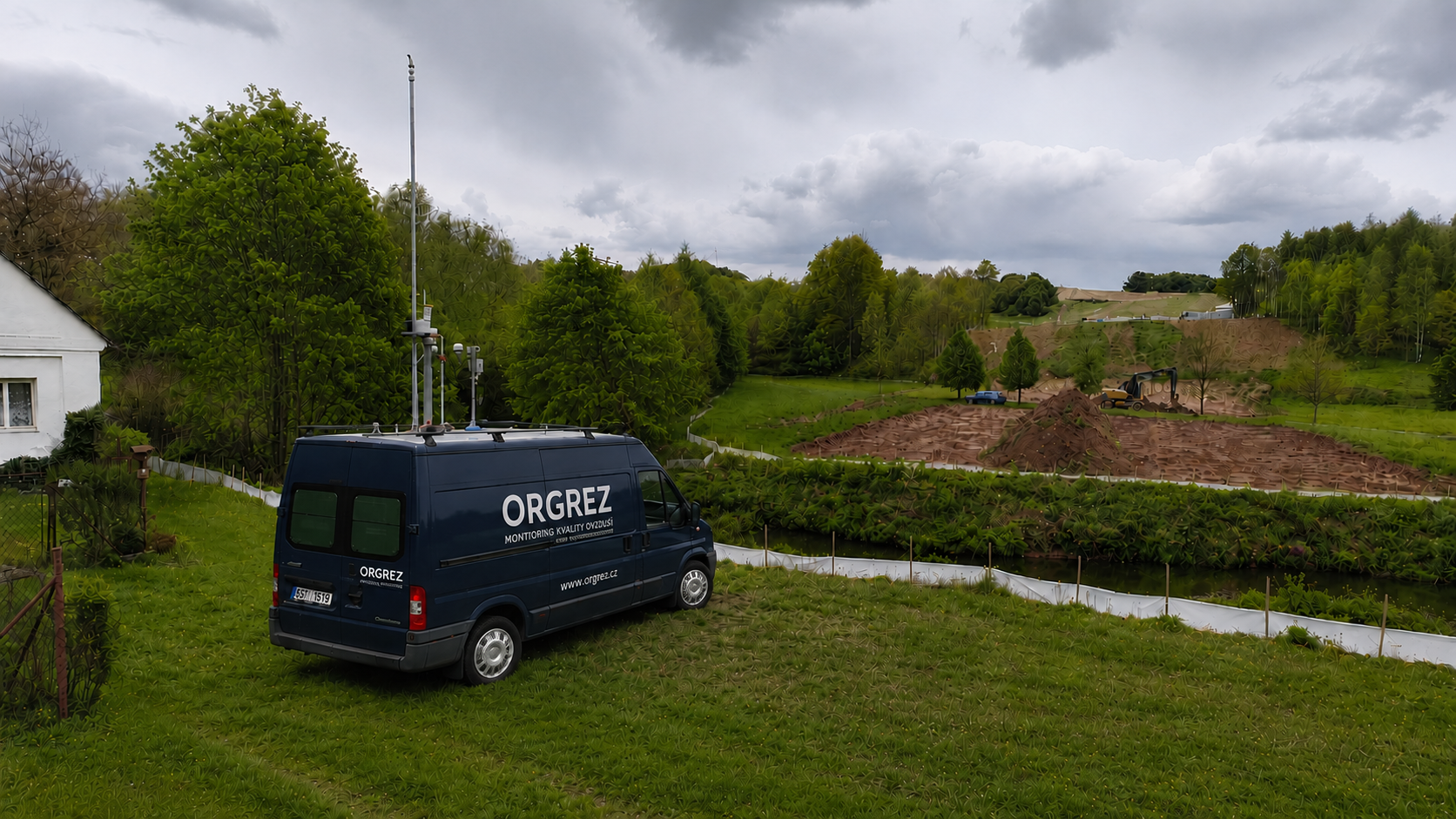
However, the service does not end with the recording of the final reading. The data then undergo validation, statistical processing and expert interpretation. A key part of the work involves assessing the pollution load in the area. Using directional concentration rose diagrams and other statistical methods, we analyse the measured data, identify likely sources of pollution and assess their impact on air quality.
It is at this stage that the individual values take on the necessary context. Where the nature of the project requires it, we link the results to other environmental sampling, analyses or air pollution modelling. The outcome is therefore not merely a set of measured concentrations. The client receives a comprehensive expert report which they can use in dealings with government authorities, in permitting processes and project preparation, when designing technological equipment, or when optimising its operation.
EMISSION MONITORING IN PRACTICE
From the design of a monitoring strategy, through the installation and calibration of measuring equipment, to validation, statistical analysis and expert interpretation of the data. Depending on the nature of the project, ORGREZ can supplement the service with environmental sampling, air pollution modelling and the assessment of likely sources of pollution. The result is a single, professionally integrated package, rather than isolated measurements.
One service, very different tasks
Our projects clearly demonstrate the wide range of applications for air quality monitoring. We have been operating networks of automatic air quality monitoring stations at major energy sources for many years. At large-scale outdoor work sites, we measure dust levels and assess the effectiveness of dust control measures. As part of the planning and implementation of linear infrastructure projects, we monitor the impact of traffic on air quality, and we use our own mobile monitoring vehicle for short-term or operational campaigns.
Another group of projects comprises specialised measurements for the design of filtration systems for data centres, combined cycle power stations and other industrial facilities. In the vicinity of ZEVO, we combine air pollution monitoring with accredited measurements of mercury in the air, aerosol sampling to determine heavy metal levels, and soil sampling for the analysis of mercury, PCDD/F and PAHs.
Our portfolio also includes projects in which we supplement the measurements themselves with air pollution modelling and expert analysis of pollution sources.
Examples of how this work is carried out in practice include the mobile measurement campaigns conducted along the D11 motorway and at EVO Komořany, as well as the Výsluní monitoring station. Each of these projects has a different remit, different conditions and a different purpose. The common thread is the need to obtain reliable data directly from the real environment and to evaluate it correctly.
Expertise, technical resources and independence
All activities are carried out in accordance with the accredited procedures of the Most Testing Laboratory No. 1139 and within the scope of the authorisation we hold as an authorised body in the field of air quality protection.
“Thanks to our in-house technical facilities, our mobile measurement vehicle, the accredited Most Testing Laboratory No. 1139 and the authorisation of an authorised person, we are able to handle the entire process – from the design of the monitoring programme through to measurement, modelling and interpretation of results, right through to a comprehensive assessment of environmental impacts,” adds Vojtěch Kopřiva.
For us, air quality monitoring does not end with measuring the concentration of a particular substance. The data itself does not provide the answer. What is essential is to evaluate it correctly, place it in context and understand what it reveals about a specific location and its pollution levels. Only then do the measured values become a reliable technical basis for decision-making regarding continued operations, planned investments, the permitting process or the design of a technological solution.
You can find out more about the air pollution monitoring service here.